On teasing untypical children

(Non-)normativity in open and closed societies
1) Samantha, her essay, and her instructor
You may have heard of the latest controversy in our ongoing culture wars — the one about that OU student who "got 0 points for quoting the Bible" in an essay. This case hits close enough to my professional and personal home that I feel entitled to chime in.
In doing so, I could tackle it from various angles. I could, for example, examine whether the 0 grade was justified. Long story short: based on the assignment instructions, it was not. Below are both instructions and essay, helpfully posted by Turning Point USA (not linked — I have beef with TP USA and I don't like linking to people I have beef with). As you can see, the instructions were to simply react to a research paper in any old way. The only limitations were a word minimum, originality, clarity, and a tie-in with the paper. Which are all present in the essay.
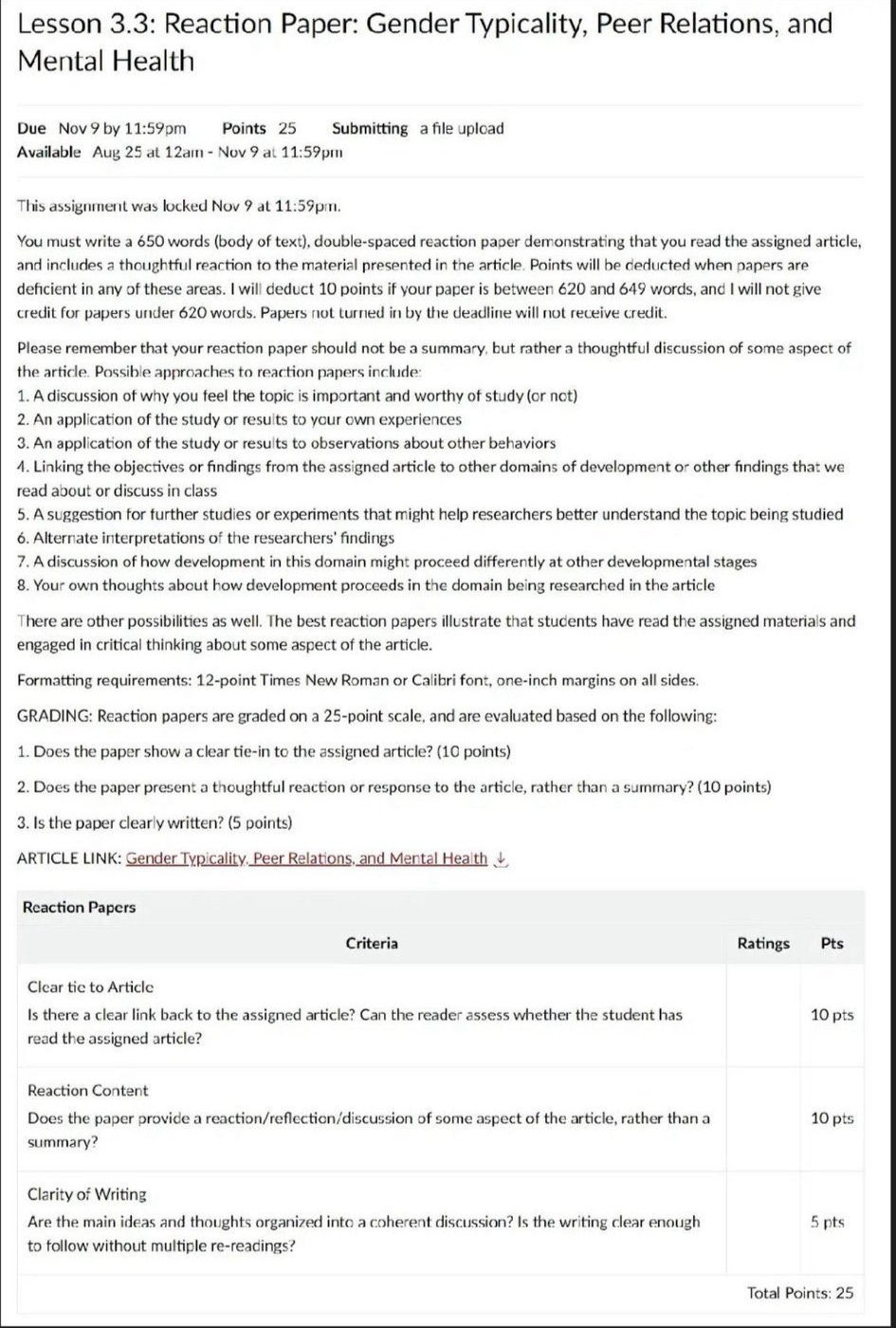


The instructor argues the essay "does not answer the questions for this assignment, contradicts itself, heavily uses personal ideology over empirical evidence in a scientific class, and is at times offensive." Again, the first statement is untrue, and there is nothing in the instructions that prohibits writing about your beliefs or using offensive language. There is a contradiction in there, though (and we'll get to it in a second), but that would only have merited points off, not a zero grade.
Was it fair to place the instructor on leave for that? No. This kind of situation is inevitable when you throw a grad student into teaching without adequate preparation or mentoring, which is the norm in academe. It takes a while to take your emotions out of grading, to write good assignment instructions that capture your intentions, and to learn to admit when they don't. Taking this common dysfunction out on a grad student because of outrage-mongering from the right is just as cowardly as the many cancellations universities have committed because of outrage-mongering from the left.
Another tack could be to inquire if the student — we'll call her Samantha, because that's her name, and she clearly enjoys the publicity — is right in her claim that she was discriminated against because of her religious beliefs (she follows a rather rigid interpretation of traditional Christianity, as you can tell). And it looks like there is no way to decide that at this point. The instructor is a transgender person, so my best guess is that they were offended at what she wrote, hence the 0 grade. It's tempting, therefore, to conclude that her religious beliefs were targeted.
That said, the instructor would presumably have responded the same way to an essay based on, say, one of the neo-pagan views that hold to a strict gender binary. Or on a strictly materialist, naturalist worldview in which there is no room for any expression of sexuality that doesn't help spread DNA. Whether this was about Christianity in particular, or simply about Samantha's anti-transgender/anti-non-conforming stance, we can't tell.
All that said, there are two problems with the essay. One is the contradiction mentioned above. Samantha asserts that teasing minors who don't fit gender norms is "not necessarily (...) a problem." Later, however, she also claims she doesn't "want to see kids teased or bullied in school." Now, for grading purposes, that's simply one of the many contradictions we humans labor under, and does not warrant a zero. From the standpoint of a bullied kid, however — and let's be honest, bullying is what we're talking about here — that difference makes a heck of a big one.
And that's the other problem: that sneaky little formulation "not necessarily a problem." The article — an empirical study, fwiw — clearly says that teasing (bullying) is a problem: kids who don't happen to fit their culture's preferred gender norms are less popular and get teased (bullied) more than your jocks and your prom queens. And boys for whom that's true suffer so much from it that they're at increased risk for mental health issues, more so even than girls who are also bullied for not fitting the norm.
Again, from a grading standpoint that warrants a point deduction for flippancy — but not a zero, given the instructions. What Samantha is saying here is that she is ok with living in a culture that inflicts emotional violence on kids, particularly boys, for the sake of enforcing its norms. (I choose the term "violence" deliberately here, because of the lasting damage this "teasing" does.) Because, she argues, those norms are clear-cut and divinely instituted. But, she's also conflicted about it. As she should be. For the Bible she references for justification also says that in Christ, there is no longer male or female (Gal. 3:28). In other words, God's love can break down worldly distinctions — even those instituted by God Himself.
All of this hits close to home for me. For I am one of those bullied boys. And a Christian. It also hits close to my professional home. If you are willing to enforce one norm through emotional violence, you open the door to doing the same with others — communication norms, say, or norms about achievement. The kid on the spectrum, the kid who stutters, the kid who speaks with a nonstandard accent, the kid who doesn't read at grade level — we know they all get bullied, and in Samantha's world, that could be ok if it serves to preserve a norm.
Hence my own sneaky formulation in the title. Nothing in this controversy is about children with special needs. But in the end, it affects all children who don't fit a given norm — who are "untypical" one way or another. As it has me. And it raises the question, what kind of culture do we wish to live in? One that upholds its norms through cruelty, or one that does so through care?
At the end of the day, the answer to that question affects us all.
2) On being an untypical boy
One day at church, a friend of mine — who, fwiw, is a pretty fundamentalist Christian — gave me his phone with a sigh. "That's what bullying does to you," he said. I glanced at the screen. It showed a buff guy in a gym. Puzzled, I looked up. "A guy from my school," my friend explained. "He always got teased for being the skinny, scrawny kid. Now he obsesses over his body. He doesn't have a life — no wife, no kids, no career. All he does is go to the gym."
Yes, that's pretty sad, I thought. It's also something that could have happened to me. I didn't tell my friend that day, but growing up in Germany I got bullied all the time for simply being who I was. Even as an adult, I was periodically reminded that I didn't "fit the bill" — well into my thirties! Little wonder I packed up and crossed the pond the minute I got the chance.
Why the bullying, you ask? Well, I too was skinny and scrawny, a foot shorter than most boys, sensitive and (on good days) caring, not very athletic, and with an insatiable appetite for knowledge and books. All of which were capital offenses against the male norm where I grew up. "Echte Jungen lesen nicht (Real boys don't read)" I heard often, as well as insinuations about being a girl, sissy, unmanly, and the like.
All the while, there are the Samanthas of this world who claim, in complete oblivion, that they don't believe anyone is "pressured to be more masculine or feminine." Really, Samantha? Only someone who has always enjoyed the unearned good fortune — the privilege — of "fitting in" (how many hardships hide behind that phrase for those of us who don't!) can turn such a willfully blind eye.
Mind you, I've never thought of myself as a gender non-conformist. I've always felt myself to be a straight male, but somehow I always missed that mark in the eyes of others. Not least because no one showed me how to "be a man." (Hint for the Samanthas out there: if you wish to uphold your norms, that works much better by invitation than by ostracism.)
Now, lest you feel too bad about me, be assured that I am now exactly where I need to be. I have a beautiful wife and two beautiful children, a house, a black belt in Karate, and a healthy amount of indifference for others' opinions of me. My recovery depended on two unique factors, though. One was meeting my wife. She is from India, and by Indian standards I am, apparently, a ruffian. (Which tells you something about the context-dependency of norms.) It's quite possible that even today I would run into problems trying to make work a marriage with a Western woman who gauges me by what she was taught about masculinity.
The other was coming to America. One big difference between the Germany I grew up in and the America where I was finally free to reach adulthood is that the latter works by invitation, by expanding norms in small acts of caring when someone doesn't quite meet them. And that, in a nutshell, is the difference between a closed and an open society.
3) Open and closed societies
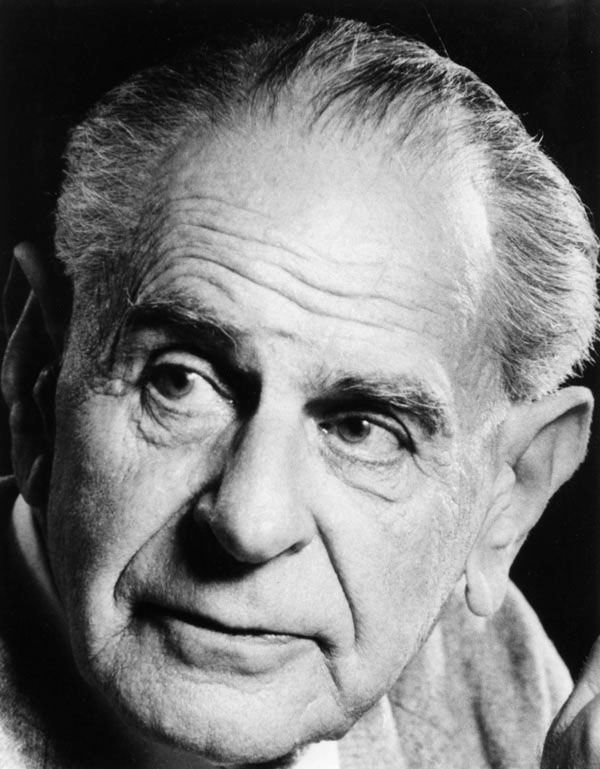
The term "open society" is usually associated with Karl Popper (1902-1994), the eminent philosopher of science. Living through the devastation of World War II, he decided that the closed societies of nationalism, fascism, and Marxism had exhausted their promise. His ideas for a liberal society founded on scientific inquiry and reason — no one has absolute truth, disagreements are resolved through experimentation and rational debate — are among the foundations of the relative peace and prosperity we have enjoyed since 1945.
They are also among the reasons why things seem to be falling apart right now. Like many liberals, Popper fails to understand that we are covenanted to each other by ties much older and deeper than reason: our human nature, our vulnerability, our mutual dependency — and the norms we concoct to keep individual selfishness in check and the communities we rely on cohesive so they can be places of mutual care. To follow reason alone means to leave society to unravel as each of us computes their own way to happiness.
Three generations into exalting "rational self-interest," the rich and powerful are doing to the country what they want, while the rest of us struggle. Our anger is skillfully redirected, by the rich on both sides of the aisle, towards those deemed "other": the gender-nonconformist, the immigrant, the racial or ethnic minority, the rural conservative, the traditional Christian. (The right is currently adding the disabled to that list, as well as... uh... tourists?)
There is, however, an older conception of the "open society." It's where Popper got the term from, and it accounts for the older ties. That's Henri Bergson's version.

Bergson (1859-1941), a French philosopher, is little known today, but during his time he was one of the most important intellectuals in the world. As well-received as he was despised (he was close to the American pragmatist, William James, while Russell and Einstein didn't think much of him), he left his imprint on much of French thought. One reason he was controversial and is now semi-forgotten is, probably, that he wove together religious and secular modes of inquiry. Which puts him deeply in touch with the human condition.
Bergson starts from the premise that norms are important. They serve to counteract the individual self-interests that would otherwise undermine social cohesion. And they do so by placing obligations on the individual. I must abide by my culture's norms or suffer the consequences. Those eventually become second nature to the person, which makes for stable but closed societies in which difference is punished. This is the default modality of human groups.
Us (post-)moderns may scoff at this. Norms are relics of an oppressive past, we might say. We are free individuals with rights. Who dares say that norms oblige us?
Bergson wouldn't entirely disagree with that. But he'd also say that even your conception of individual rights and freedom is a norm, and — as his student Simone Weil has pointed out — obligations logically precede norms. If you say "I'm free and have the right to do what I want" and no one around you feels obliged to grant you rights or freedoms, you're just saying words without meaning. Only in a society that explicitly recognizes everyone's obligation to safeguard others' rights and freedoms do those exist in any meaningful way.
And I'm going to posit that we live in such a society. In America, we have our founding ideals as our most basic, binding obligations: the belief that we are all born equal, with the right to life, liberty, and the pursuit of happiness. And each of those is God-given, that is, quite independent of human whims.
This makes America an open society by default. Bergson doesn't talk much about differences in national cultures, but his concept of an open society jells quite well with what I have experienced in the States. Open cultures, he says, are those that make room for those who are different by extending the norm in question until it includes them. They do so via, well, bouts of love. Here is where it gets a bit mystical (his term, not mine).
In Bergson's telling, open societies have just enough room within them so that occasionally, a mystic can arise: someone who is able to connect intuitively with the creative force of love when faced with a difference or the need to change a norm. The mystic then draws others to this overflowing of love, and eventually society changes and creates a new, more expansive norm. Note how norms are still important in this telling! But they are never fixed once and for all, nor ends unto themselves.
Those rare mystics Bergson invokes involve the usual suspects: the biblical prophets, some Greek philosophers, the saints, and of course Christ himself. We may add to the list Gandhi, Martin Luther King, or Nelson Mandela. (Perhaps the Founding Fathers, too? Or were they too flawed a bunch? — Discuss.) I have to disagree with him on that, though. In my experience, the ability to intuit where love must trump norm is much more (lowercase) democratically distributed than he makes it out to be. Small acts of caring make big differences, and they are found everywhere. And I do believe cultures can foster or hinder them.
Which also means most cultures aren't fully closed or fully open. Societies exist on a continuum of closed-to-openness and move back and forth on it depending on their present needs and the vagaries of history. Thus, when I paint Germany as closed, that's not entirely fair. My experience there was based on my particular station in life, in a very specific period of history (the aftermath of WWII). Likewise, the US has been open to me but isn't all that open to many others, including some of her own. Still, the differences are big enough that others have noticed them, too. Like Tocqueville, who spoke of the ease with which Americans form associations. Or a guy named Becker, writing ca. 1920 (don't ask how I find stuff like this).

Why would American culture be open that way? I see two factors here. One is how the country came into being (see above). In European history, you find all the ingredients for closed cultures: people living in one place over generations, frequent warfare, static social structures. Thence you get mistrust of outsiders and of difference, and a habit of clinging to the status quo. America, by contrast, had to be built from scratch: by people from quite different backgrounds who were free to join a community one day and leave the next. The perfect ingredients under which openness doesn't only become possible but necessary.
The other is our relative conservatism compared to much of Europe. (Note that I've only lived in the South in my time here.) A people rooted in healthy love for country and family can be more open than a people that does not quite know who they are or what they stand for. This also includes our exceptional religiosity. No matter what I could say about the failures of cultural Christianity — and there are many! — if a large swath of your population actively follows a guy whose main work on earth was to include the excluded, that is going to rub off on the culture in some way.
4) The importance and the ambiguity of norms
So, to sum up, norms are important, because they presuppose obligation, and thus keep community coherent. And gender norms in particular are among the most deeply felt of them. Because they are rooted in biology, that is, the fleshly reality of our very bodies and the specific ways in which they give us pleasure, pain, and the tremendous responsibility of procreation. No wonder people are so reluctant to see them change.
Even so, very little about them is set in stone. They change all the time. They have fuzzy boundaries. And they differ from culture to culture.
Take me and my wife, for example. Yes, I am a husband to her: she relies on me for important decisions, for breadwinning (we both work, but I make more money than her), long-distance driving, and emotional support. Yes, she is a wife to me: she is more involved with the children, for example, and feels compelled to produce a delicious dinner every night. Sounds pretty "trad," right?
But I also support her in getting her PhD, and I am fully ready for the day she starts making more money than I do. (And she will - her PhD is in AI.) In the meantime, we share many a geeky interest (history, culture, spirituality) that we chat about over laundry. Which adds a beautiful dimension of togetherness that wouldn't happen if I didn't work the laundry with her.
For some cross-cultural comparison, I give you the pics below. The first shows the New Zealand women's rugby team doing the haka (a traditional Polynesian war dance). Each of them ladies could kick my rear, and yours too. And yet, are they not women?

Next, I give a group of Indian guys. They may not look super-masculine when compared to American standards of buffery (and notice the group hug — physical contact between men is quite common there, and there is nothing homosexual read into that), but like all Indian men, they are expected to marry and be absolutist rulers of their household the way that some on the far right here seem to be dreaming of.

Which, btw, is a main reason my wife left. A quite feminine lady by Western standards, she was considered a tomboy in her culture — can you say "untypical?" — and not ready to submit as expected from an Indian wife.
I could go on, but you get the point. Norms differ between cultures. Some people fit their culture's norms perfectly, many don't — and even those that do are on shifting ground, since norms themselves are alive, if you will, constantly adapting and rearranging themselves in small acts of caring. (At least in sufficiently open societies.) In the end, don't we all live our lives in some "good-enough" fashion, sometimes even recognizing, wisely, that almost no one fits every single prevailing stereotype? Surely somewhere in all that ambiguity there is enough room for the occasional non-conforming or trans kid.
The same is true for ability. As Alasdair McIntyre and Tom Shakespeare have shown, ability and disability aren't truly separate categories. Granted, they seem to be when you compare, say, Einstein to someone with a severe intellectual disability. But if you look for the line that separates being a bit slow from having a mild ID, you won't find it. It changes with the assessment you use, the individual's momentary functioning, the official definition of ID, and so forth. In other words, (dis-)ability exists on a continuum shaped by context. Which makes the differences between "normal" and "not normal" suspect.
5) Norms as agonistic purveyors of meaning
As we saw, despite their ambiguity, norms exist for a purpose, viz. cohesion. But there's more. Norms also provide shared meanings by which individual actions gain significance. To paraphrase Charles Taylor, if tomorrow I decide that the ability to wiggle my toes is the center of my individual identity, I will not be taken seriously because I have made an arbitrary choice with no reference to any shared understanding. There is nothing recognizable, to anyone, about an identity based on toe-wiggling skills.
That's what makes current far-left discourse about gender so corrosive. (This is the only good point Samantha makes in her essay.) Gender identities are serious matters, recognized by others precisely because, more so than other identities, they are shaped by our very biology and by a deep sense of self that does not depend on willful choices. They develop over time, sometimes despite what their bearers feel about them, and in untypical individuals they do so against all kinds of forces lined up to level them. To say all this is a matter of willful choice is to take that gravitas away from them and make them arbitrary — that is, meaningless.
And yes, that means unearned privilege and unjust suffering may not be fully avoidable. That's why I call norms agonistic purveyors of meaning. Some of us simply sail through gendered life, fitting in effortlessly wherever they go, dominating the picture. (Hi, Samantha.) Most of us don't. In a truly open society, those who do would recognize their privilege and, moved by the creative force of caring, use it to extend the norm to include the person in front of them. As it stands, that is not typically the case. But that cannot be fixed by simply creating a new norm, ex nihilo, that inverses the polarity of closedness and of privilege.
In fact, the very norms that make us suffer also give our identities stability and confidence. As a somewhat non-trad straight male who has suffered from being who I am, I have earned my confidence in who I am as much as my right to snicker at silly cosplays of masculinity because I know how fragile such "masculinity" is, how much it depends on excluding others. Likewise, the kid who knew they're transgender at age 4 and have stuck with it against all pushback has earned their confidence in who they are, and the right to be taken seriously and to be supported in every way. The same is true for the consistently nonconforming kid, the old-school tomboy, the gay teen, and so forth.
(This is also why I am deeply skeptical about the recent surge in minors who all of a sudden claim to be transgender. There is every reason to suspect that many of them are doing so to cope with some kind of distress, and the medical establishment in America is committing a great injustice subjecting these kids to invasive treatments. — And in normal years, this is how I teach the topic. Being in Texas, I am quite shielded from wokeists to whom all this is a no-no. Ironically, this year, being in Texas I may not be able to teach it at all.)
We may call the idea that gender is a choice a liberal fallacy. Conversely, conservatives tend to commit the opposite fallacy, that is, to see norms as eternally fixed and immutable. Thence they resist extending them because they fear their erasure, and with them the erasure of cohesion and shared meaning. And I sympathize with that. An amount of gender complementarianism, for example, is desirable because it keeps life interesting. (We may think about it as a variant of diversity!) But a bounded, contextual, malleable complementarianism will not rely on naive assumptions like Samantha's, where men do manly things, women do womanly ones, and never the twain shall meet.
Conclusion: Open societies — neither "conservative" nor "liberal"
Given all that's been said, you may be tempted to think that open societies are simply "nice-to-haves" — that it's more important to be stable, as a society, than to include everyone. Bergson issues a warning on that. Watching the breathless progression of modernity, he cautions that if we do not keep our societies open enough to make room for real human beings — including those different from us! — we may lose our humanity itself as we are more and more conformed to the mechanistic norms of our own inventions (economics and technology). — Any factory worker of the 1920s could tell you a bit about that, as could today's SLPs laboring under crushing paperwork and productivity demands.
Then there is the not-so-small matter of justice. As we saw above, it seems inevitable that norms produce unearned privilege and unmerited suffering. This is an injustice, and while Bergson doesn't have to say much about it, it's one that I will never take lightly. Not just because I have suffered from this exact injustice, but because I try to follow the One who extended his care precisely to those who suffered from exclusion. The norm Christ imposes on me — the norm of openness, the command to choose bouts of caring over clinging to rigidity — is the one norm I can never go behind.
I suspect we have, as a culture, become too open in some ways. (I'm sure Bergson would agree there is such a thing.) Conservatives have long argued, for example, that the evaporating of traditional sexual mores during the 1960s has greatly harmed the working classes, and more recently, some liberals have begun to chime in. Or take immigration. An immigrant myself, I wish nothing but good fortune on those who feel compelled to leave their home — but I wish the same on those who feel like they are losing theirs to newcomers. (And I am joined in that by no other than Barack Obama.)
All that said, our present-day far-right "conservatives" — the nationalist, MAGA types — are not simply trying to scale back openness. They are clearly pushing for the rigid norms of a closed society. (Witness Samantha's essay.) And they utterly fail to understand the dangers of that. Or maybe they don't care, because they think themselves immune.
There are three. One, as both Bergson and Popper witnessed personally, rigid closedness tends to lead to large-scale violence. That's because it needs enemies to justify itself. Especially in complex, modern societies with lots of internal differences. Their suppression can only be justified by invoking the danger of the "other." (Witness the cruelties we're presently seeing inflicted on immigrants and dissenters.) Closed societies are always in danger of stumbling into the one, devastating war — civil or external — that will undo them.
Two, as Bergson understood a hundred years ago, the accelerating pace of technological change and economic dynamics requires constant reorientation towards what it means to be human. (This is only amplified by the since-added dynamic of climate change.) In other words, it requires a degree of openness. Fail to attain that, and the Peter Thiels and Elon Musks will turn us into worker ants slaving away in their clueless empires where the only norms are pointless efficiency and aimless productivity.
Three, rigidly closed societies are brittle. One norm fails, and everyone who believes in it goes hysterical. That's the hour of myth-making, as Bergson calls it. The old explanations have failed, so new ones need to be found, no matter how. Which is fine if external conditions haven't changed too much. If they have, however — as in our situation — the old repair mechanisms fail. This is where we get the utter nonsense from that permeates our discourse these days — QAnon, J6, "everything is racist," "gender doesn't exist," pet-eating Haitians, or Peter Thiel's "if you don't let me do whatever I want with AI, the Antichrist will come!"
It's clear, therefore, that we aren't simply involved in a struggle between a more open, "liberal," and a more closed, "conservative" idea of society. Liberalism has spawned its own version of closed norms. The progressive, "woke" left labors under illusions very similar to that of the MAGA right. They, too, believe that their norms are absolute, unchanging, and must be enforced by emotional violence and ostracism. It's where we get the cancel culture from that is now gleefully embraced by the right.
No, a more appropriately open and more caring society would involve elements that are both liberal and conservative. Liberal in the classic sense of the term, harking back to the revolutionary idea of the equality of all, but also in the sense of economic solidarity that used to be common sense in the New Deal era. Conservative in that it would do a better job at maintaining healthy boundaries, both physical and normative: in the keen awareness, as one writer has put it, "of the value of our civilizational inheritance, the fragility of moral and political order, the limits of human understanding, and the perils of revolution."
Whatever name you give to it, I think it's clear that what I'm advocating for here is a culture much like the one I found when I crossed the pond, with the crucial, added dimension of economic solidarity. Conservative by German standards, but at the same time more open to difference. Caring in multitudes of small ways. A culture where bullying is not the norm but the caring extension of norms is (here's looking at you one last time, Samantha). And I hope you understand when I say, given my personal history, that I'm ready to fight like hell for it.
All views expressed in this post are mine. None of them shall be construed to represent, in any way, the official, government-sanctioned views of my employer. Back in the day, when we still had full academic freedom, that would have gone without saying - the very point of academic freedom was to allow professors to speak from their best understanding, with no political or administrative interference. As it stands, those days seem to be over.


This discussion highlights something many online users care about today: simplicity and usability. Websites that are easy to navigate usually create a much better overall experience for visitors. After checking out hellosays, I found the interface practical, clean, and suitable for users searching for straightforward online resources.